
It’s a truism that editors focus on words. But there’s more that editors need to be aware of, particularly when combing through final designed page proofs.
The story of a gene hunter
A girl grows up in California in the 1950s, the daughter of a prominent psychoanalyst father and a mother with a Master of Science in zoology, focusing on genetics. The girl’s family has a secret, but she doesn’t know that yet.
“Even as a toddler, I had become accustomed to the micro-moments when Mom would seem to go elsewhere. A flash of blankness in her eyes. A lost beat in the conversation. And then, almost before it happened, it passed and she returned.”
The girl grows through childhood and adolescence, experiencing both ordinary and extraordinary moments. In her 20s, just starting a graduate degree, the woman learns from her father that her mother has a hereditary disease: a disease that has already claimed the woman’s three uncles and grandfather, a disease that confers on the woman and her sister a 50 percent chance of inheriting it themselves.
“…the uncertainty of 50-50, the haunting probability of 1 in 2.”
In the years to come, the woman witnesses her mother’s decline. Her mother becomes bedridden, and later not just bedridden but literally tied to her bed to prevent injuries from the uncontrollable movements of her limbs. Eventually, her mother dies from the debilitating hereditary disease.
“Sunday, May 14, Mother’s Day: My mother has died tonight. …. A tremendous force which has guided and impinged and constricted and shaped my life has left.”
The woman graduates with a doctorate in clinical psychology and, without initially meaning to, she embarks on a career with the goal of “finding a cure for this deadly disease.”
The woman assembles and leads a team to search for the gene responsible for causing the disease. This quest, happening before the Human Genome Project exists, is a tall order.
“…like searching for a single person in the United States without a street address, or even the name of their street, city, county or state.”
As part of the search, the woman spends a month at a time, every year for more than two decades, in Venezuela, where some regions have a disproportionately high population with the disease. There, the locals call the disease el mal de San Vito, Saint Vitus’s disease.
“Nearly half the people [here] suffer from el mal or are at 50% risk.”
The woman and her team of neurobiologists, geneticists, nurses, social workers and others get to know the local families afflicted with el mal. The team draws on groundbreaking work by a Venezuelan doctor who, decades earlier, had identified the disease in these families and had cared for them.
“Because they love [the doctor], they open their homes to us.”
The woman and her team earn the Venezuelan families’ trust, and together they create an enormous family tree to help them understand the ancestry and inheritance patterns of the disease. The families agree to the woman and her team taking blood samples to analyze their DNA and doing neurological and cognitive tests to follow the disease’s progression.
“I explained that my mother had also had el mal. I said that I and they probably would be able to confirm that we were related to each other if we could draw our family trees back far enough.”
In return for the Venezuelan families’ willingness to participate in the research, the woman and her team bring medical supplies, offer counselling, and find a local doctor to join their efforts and work year-round caring for the families. Later, the team helps advocate for and find funding to open an outpatient clinic and nursing home for people in later stages of the disease.
“To be able to give people who had suffered so much this safe harbor, this haven where they would be cared for with dignity and respect—that meant everything to me.”
Within just three years, the woman and her team find a genetic marker, like a signpost that points to the chromosome neighbourhood where the gene resides.
“To add to the magic, [the] group identified the marker on Chromosome 4 on August 4.”
Finding a genetic marker is a major step forward; it greatly narrows the search field for finding the gene itself. And it allows for a test that can predict who will develop the disease before symptoms appear.
“For all the larger significance of this discovery, though, for me the joy was knowing that, at last, we were closing in on the gene.”
The woman’s team morphs over the years, and she organizes a group of biochemists, biophysicists, molecular geneticists, neurobiologists and others from six different labs. Not only do the participating scientists share all their results with each other, they agree to share credit for the group’s work, a highly unusual arrangement. The woman and her team start calling themselves the Gene Hunters.
“I used to tell people what we were doing was like flying to the moon while inventing the rocket.”
The years tick by, ten of them. And then, finally, the Gene Hunters find the culpable gene.
“I … remember instantly feeling the responsibility of safeguarding world-shaking news.”
All this while, through decades of holding meetings, writing grant proposals, organizing research trips, and analyzing data, the woman lives her life without knowing whether she too will succumb to the disease. For 50 years, she knows only the statistic.
“…the uncertainty of 50-50, the haunting probability of 1 in 2.”
At first there’s no way for the woman to know her fate; later, after the marker discovery, the woman chooses not to know, not to take the predictive test her work made possible.
“Even a negative test might pose complexities. After building one’s identity around the idea of living at risk, learning that one was free of the aberrant gene could require a dramatic recasting of self.”
In her 70s, with physical signs of the disease mounting and with the prospect of joining a clinical drug trial, the woman agrees to testing.
“…that 50-50 probability turned against me. … It was devastating, but not surprising.”
The woman has the gene she helped to discover. She has Huntington’s disease. Her sister does not.
This story isn’t fiction. It’s the life of Nancy Sabin Wexler, and it’s the story she tells in her recently published memoir, My Life, My Science: Pursuing a Cure for Huntington’s Disease.
Nancy began writing the book less than a year after receiving her diagnosis, and as the disease progressed and began to rob her motor control and her speech, she invited two people to help her complete the manuscript.
“I had the gift of collaborators—Mark Hampton, a playwright and screenwriter, and my sister Alice, a historian and biographer—who would help me tell my story without ever telling my story for me. It became my voice in three-part harmony, with me carrying the melody.”
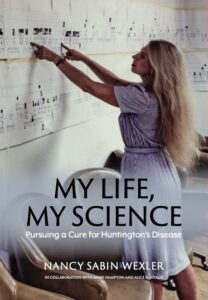 The resulting book is a beautifully written memoir of secrets and revelations, of hopes and frustrations, of loves and losses, of scientific discoveries and beautiful lives. Most of all it’s a story of fierce determination and, in Nancy’s words, “an affirmation of life, my own and that of many others, of an entire community dedicated to breaking the chokehold of this disease.”
I had the pleasure of working with Mark Hampton and Alice Wexler for several months to edit Nancy’s book before it was acquired by Cold Spring Harbor Laboratory Press, which published the book in April 2026. Nancy Sabin Wexler, now Higgins Professor Emerita of Neuropsychology at Columbia University and still President of the Huntington’s Disease Foundation (started by her father), lives in New York City and remains an advocate for those living with Huntington’s and other neurodegenerative diseases.
Related Posts

Comments (0)